Rescue journal
How to Introduce a Rescue Dog to Your Dog
The first meeting is not a test of whether two dogs will become best friends. It is a chance to make both dogs feel safe, heard, and unhurried while they begin to share a bigger world.

Bringing home a rescue dog while another dog already lives with you can feel like a very big day. There are new smells, a changed routine, car rides, bags, people, and often a dog who has already had several transitions. Your resident dog may be curious, pleased, unsure, or all three over the first few days. The rescue dog may need time to show who they are.
A calm introduction gives everyone useful information. It does not promise that the dogs will play immediately or sleep together that night. It does give you a safer way to notice their comfort, set up the home thoughtfully, and adjust before tension has a chance to grow. Your rescue or foster coordinator should always be the first source for dog-specific history and instructions.
For a new dog who is still learning the rhythm of your home, begin with our rescue dog settling-in guide. A predictable routine and a quiet place to rest make every later introduction easier.
Prepare before the dogs see each other
Do a little setup before you leave for the meeting. Ask the rescue what it knows about the new dog’s experience with other dogs, handling, food, toys, and confinement. This is not a label or a guarantee. It is information that helps you choose the safest first plan. Share the same honest picture of your resident dog.
Plan for two calm adults, one per dog, and choose a quiet outdoor place neither dog treats as home turf. Bring ordinary, easy treats if both dogs can have them, waste bags, water, and secure well-fitted walking gear. Leave toys, balls, chews, and a crowd of well-wishers out of the first meeting. You are creating a low-pressure walk, not a party.
At home, put away food bowls, chews, favorite toys, and beds that either dog may value. Set up two separate resting areas. A gate, separate rooms, or crates that each dog already handles comfortably can give you a safe way to pause. Best Friends Animal Society advises removing items that can create conflict before bringing dogs into the home, then separating them whenever nobody can supervise.
Start with a parallel walk
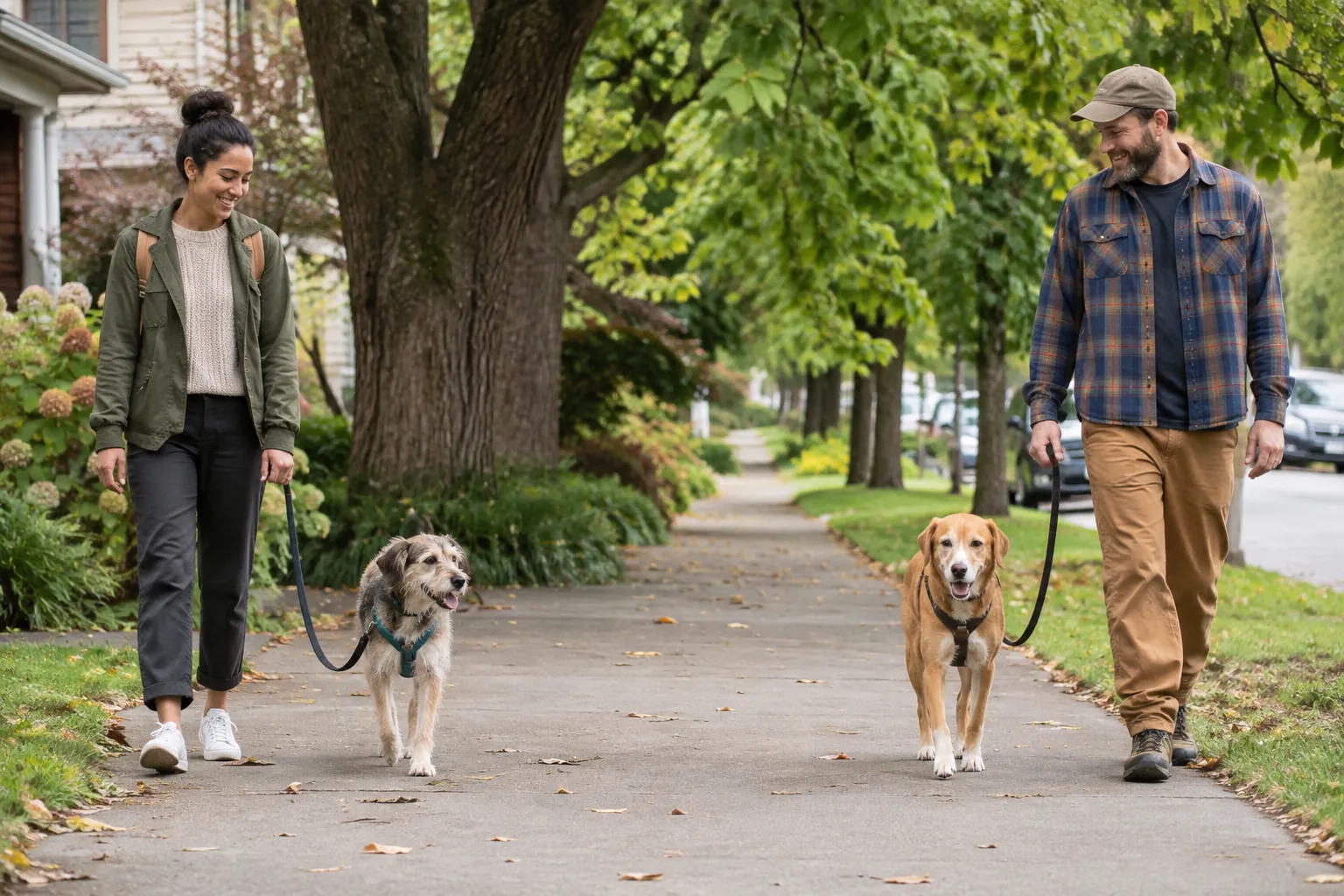
Begin with the dogs walking in the same direction, far enough apart that both can notice the other without becoming tense. Best Friends suggests beginning around twenty feet apart, but the right distance is the distance at which these particular dogs can breathe, sniff, look away, and listen to their person. It may be closer or much farther away.
Keep the leads loose enough to avoid adding frustration. A tight leash can change how a dog carries their body and can make a simple sighting feel harder. Walk for a few minutes, reward each dog for checking in calmly, and let the dogs take in the other’s presence without forcing a greeting. If either dog fixes their gaze, freezes, vocalizes, pulls hard, stops taking food, or looks unable to disengage, calmly increase the distance.
There is no prize for closing the gap quickly. A successful first walk might simply be two dogs moving in the same direction with room between them. That is useful progress because both dogs are learning that the other dog can be nearby without pressure.

Let a greeting be brief and optional
When both dogs have softened, sniffed, and walked comfortably, you can gradually bring the paths closer. Approach in an arc rather than marching them straight toward each other. A few seconds of relaxed sniffing may be enough. Call them apart while it is still easy, then walk on. Ending a good moment early is kinder than waiting for one dog to become overwhelmed.
Look at the whole dog, not one signal alone. Loose movement, curved approaches, normal sniffing, shaking off, and easy pauses can suggest comfort. Stiffness, a hard stare, low growling, avoidance, tucked body language, repeated mounting, or frantic pulling are reasons to make more space. The Best Friends introduction guidance makes the same point: only bring dogs closer when both look relaxed and pleasantly interested.
Do not punish a growl. It is a warning that lets you act before a dog feels they need a louder response. Calmly separate, let both dogs decompress, and return to an easier version of the plan later if it is safe to do so. A greeting does not have to happen at the first meeting.
Bring them home without creating competition
After a calm outdoor meeting, walk the dogs toward the home together if the route allows. Then bring them into a quiet, prepared space with a handler for each dog. Keep the first indoor session short and ordinary. Let them investigate at their own pace rather than placing them face to face or encouraging excited play.
Feed the dogs separately. Keep chews, treats, toys, and favorite resting places out of shared sessions at first. Give each dog a clear place to retreat, and do not let either one follow the other into a corner or bed. The RSPCA’s introduction guidance also emphasizes health checks and gradual management, including giving the new dog room to explore while the resident dog has a separate walk.
Use a gate for short, calm visual contact if that suits both dogs. A gate is not a place to leave dogs to bark at each other. It is a tool for a quiet reset, a treat scatter, or a chance for each dog to rest on their own side. If either dog is getting wound up, cover the view, increase distance, or separate them in rooms.

Give both dogs a slower first week
For the first days, keep life deliberately small. Walk dogs separately when that reduces pressure. Feed separately. Give each dog their own bed or quiet room. Supervise shared time, then separate them for naps and when you leave the house. This is not a judgment about either dog. It is a way to let both dogs learn the routine without needing to negotiate every resource at once.
Keep affection and attention calm, too. Your resident dog does not need to lose their familiar walks, resting place, or one-on-one time because a new dog has arrived. A short solo walk, a quiet cuddle, or a familiar training game can help preserve their sense of routine. The new dog also needs time with you without another dog nearby. Making room for each relationship reduces the pressure to make the dogs entertain one another.
Watch how each dog recovers after a shared moment. Can they settle, sleep, eat normally, and move away easily? Do they become more relaxed from one meeting to the next? Notice practical details such as who follows whom through a doorway, whether either dog begins to avoid a room, and how both dogs respond when you stand up or pick up a leash. Progress often looks boring, and boring is good. Two dogs peacefully existing in the same home is more important than two dogs playing on cue.
Rescue dogs sometimes reveal new behavior after they have had time to decompress. The American Animal Hospital Association notes that routines and personality can emerge over the first weeks and months after adoption. Keep sharing useful observations with the rescue and your veterinarian. A change in appetite, energy, pain, or behavior deserves attention rather than a guess.
Know when to pause and get support
Do not continue introductions if either dog has bitten, tried to bite, repeatedly lunges, panics, guards food or space, or cannot calm down after separation. Safety comes first. Contact the rescue, your veterinarian, or a qualified reward-based trainer or veterinary behavior professional who can see the dogs and build an individualized plan.
Pause for physical concerns, too. Pain, illness, poor sleep, a sudden change in appetite, or a new medication can make a normally social dog less able to cope. A veterinary conversation can rule out discomfort before you assume the difficulty is a training problem. Keep notes about what happened just before and after a tense moment, including distance, location, food, visitors, and how long either dog took to settle. Those details help a professional give more useful advice.
Some dogs are not comfortable living with another dog, and that does not make them bad dogs. A patient plan may include permanent separation inside the home, a different foster placement, or choosing a single-dog household. The kindest outcome is one that protects both dogs’ welfare, not one that forces a picture-perfect friendship.
If your dogs are ready for everyday confidence-building practice after the introduction, our rescue dog training guide keeps sessions small and reward-based. For broader dog-to-dog comfort, the rescue dog socialization guide can help you plan walks and outings without rushing greetings.
A first-week checklist for two dogs
- Ask the rescue what it knows about the new dog’s history and follow its instructions.
- Use two handlers and a quiet neutral outdoor space for the first meeting.
- Begin with a parallel walk and enough distance for both dogs to stay loose.
- Keep greetings brief, optional, and easy to end.
- Put food, chews, toys, and high-value items away before shared indoor time.
- Feed separately and give both dogs their own resting place.
- Supervise shared time, then separate when you cannot watch.
- Slow down or get professional help at the first sign that either dog feels unsafe.
The goal is not to rush two dogs toward a particular relationship. It is to keep showing both of them that home is predictable, their needs will be noticed, and there is room to move away when they need it.
Keep care close in the everyday moments
Nurse&3dogs is for dog people who know that care is usually quiet, practical, and repeated. When you are ready for a comfortable layer for patient walks and ordinary errands, browse the rescue dog T-shirt collection, the rescue dog hoodies, or thoughtful gifts for dog people.
Frequently asked questions
Where should a rescue dog meet my resident dog?+
Choose a quiet, neutral outdoor place with room to move, rather than bringing the new dog straight through the front door. Start with two handlers walking the dogs in the same direction at a comfortable distance, then close that distance only when both dogs look loose and calm.
How long should I keep two dogs separated at home?+
There is no fixed number of days. Use management whenever you cannot supervise, keep food and high-value items separate, and let each dog have an easy resting place. More shared freedom comes after repeated calm interactions, not because a calendar says they should be friends by now.
What if either dog growls during the introduction?+
A growl is useful information that a dog needs more space or less pressure. Calmly separate the dogs without punishment, make the next setup easier, and ask a qualified reward-based professional for help if either dog repeatedly freezes, lunges, snaps, guards resources, or cannot recover.
Should I let the dogs work it out?+
No. Dogs should not be left to resolve a tense situation alone. Thoughtful management, short supervised sessions, and a slower plan protect both dogs from rehearsing a frightening conflict.
Sources
Best Friends Animal Society, how to introduce dogs to each other
American Animal Hospital Association, what to expect after adopting a rescue dog
Related posts
 Rescue journal
How to Socialize a Rescue Dog
Build comfort around people, dogs, and new places at a patient pace.
 Rescue journal
How to Help a Rescue Dog Settle In
Make the first weeks quieter, steadier, and easier to understand.
 Rescue journal
How to Foster a Dog
Prepare a calm, supported start for a dog who needs a temporary home.